
Thesis Christ – “Piercing Daughterhood: Cloth, Gender, and Memory”
By Henry Kendrick
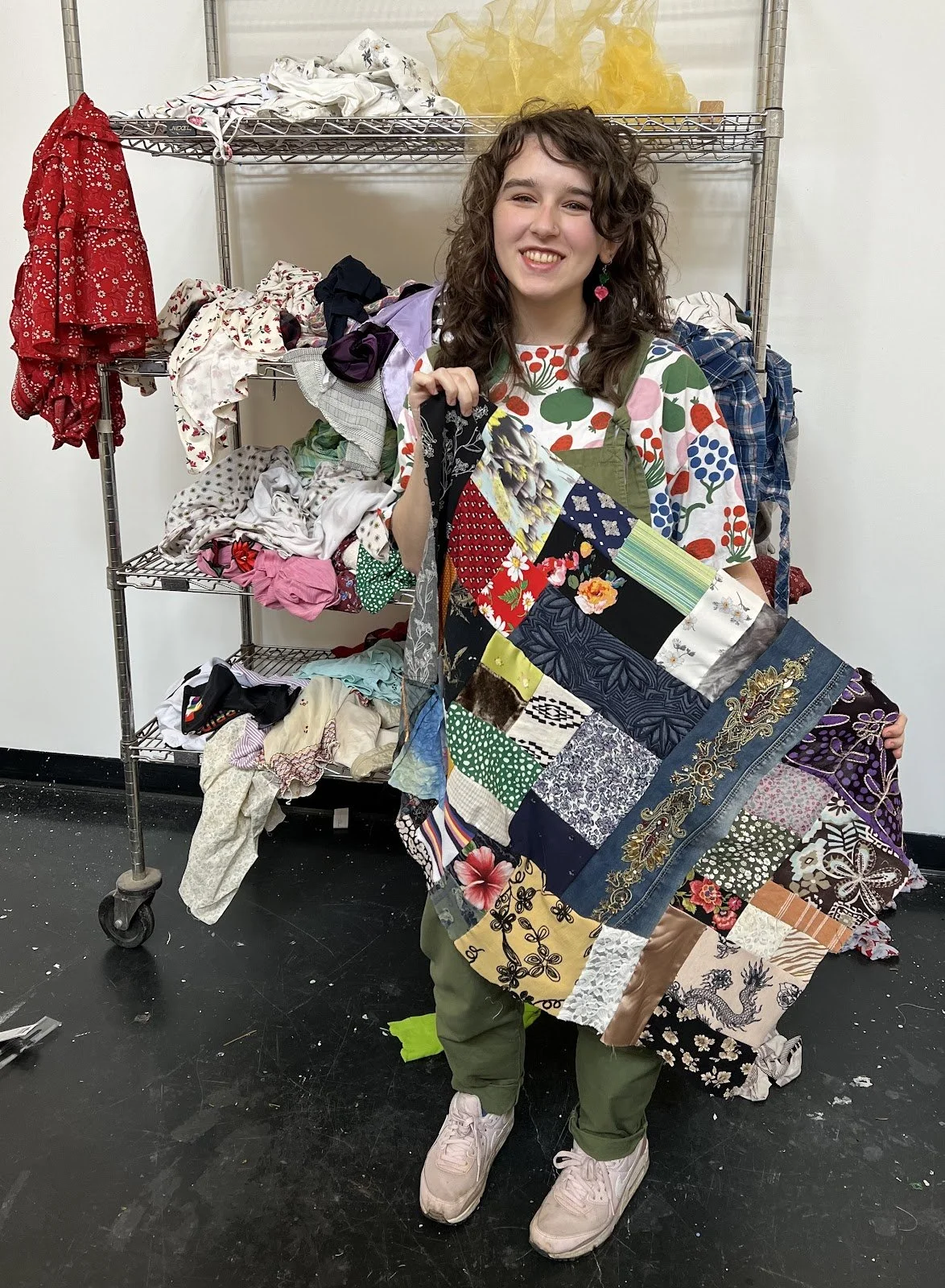
Rivi Yermish ‘24 poses with their work-in-progress quilt.
What-ho! Thesis Christ is risen! For the first column of the Spring 2024 semester, the Questspoke with Rivi Yermish, a studio art major thesising on the cultural history of quilting as an art form in the United States and how the process of quilting can offer an emotionally and creatively fulfilling way for transgender and nonbinary individuals to engage with the clothing that they might discard during or after their transition. Parts of our conversation have been edited for clarity.
The research component of Yermish’s written thesis focuses on the cultural history of quilting and its entrance into the wider visual art world, as well as analyzing the artistic themes of what they describe as “queer textile art.” “My first chapter is kind of setting the foundation for how quilts interact with the art world because it's sort of a complicated history because quilting has been a historically female-dominated space,” said Yermish. They spoke about how when quilts, carried aloft by the burgeoning feminist movement of the 1970s, were beginning to be showcased in art galleries, many critics weren’t sure what to make of them from an analytical and critical perspective. According to Yermish’s research, many critics of the time evaluated them as paintings, or referred to their technique as “painting with cloth,” while other critics attempted to create new frameworks in order to evaluate quilts as their own artistic medium. Yermish personally prefers the latter, telling the Quest, “I think calling them paintings is a little reductive because it's sort of trying to fit quilts into a framework of critique that is sort of the male-dominated established art space instead of being like, ‘no, these are their own thing worthy of their own critique.’ … So I don't think it is right to refer to them in the same space because I think if you refer to them as paintings with cloth that is always putting them as lesser paintings, instead of as their own thing.”
Yermish revealed that one of the most prominent quilting groups to receive critical acclaim were the so-called “Gee’s Bend quilters,” a tight-knit group of Black women from Gee’s Bend, Alabama, whose quilts were considered masterpieces of craft, style, and meaning. But Yermish believed that holding up their work as painting masterpieces was a kind of artistic misrepresentation of what these quilts actually were, what they were made for, and why. “A lot of them are made of scraps: old denim, work clothes. Because these women were basically too poor to buy new cloth and the quilts were very much needed to keep warm and this is what they had. But the art world kind of idealizes them while ignoring the women behind it, because even now that these quilts have kind of exploded in popularity, these women are all for the most part still very poor. So even though the work gets a lot more acclaim now, the art world just kind of took it and ran with it. And didn't necessarily honor the people behind it.”
Many historical quilts, however, are impossible to attribute to a specific artist because quilting is and always has been a folk craft, in which the outcome was a useful blanket made from recycled material, not a work to be displayed in a gallery. “People were making something that was beautiful and interesting, but not necessarily thinking of themselves as artists,” said Yermish, while also explaining that in the late 1800s, a shift began to occur in which quilting became less of a necessity and more of a pastime, especially with the advent of so-called “crazy quilts.” These often look very messy and slapdash, but were actually meant to be decorative and were often made from very expensive bits of fabric, like silk and velvet, and women of the time could even buy kits to work through in their spare time.
Yermish made it clear that quilting’s acceptance into the world of visual art was always going to be uneasy: taking something meant for real-life use and displaying it out of its intended context. “Quilts are for the most part utilitarian,” explained Yermish, “so their position in the art world is weird because a lot of the art world doesn’t like utilitarian objects. I think there's something about art being in a museum –– the museum wants it to be kind of useless.” Nevertheless, Yermish attributed quilting’s artistic viability to the historical mythology that surrounds it, even if it may not be entirely accurate to the craft’s true development. “There's this pervasive myth that quilting is American because the women in the pre-Revolutionary War era were saving every scrap – they were being super frugal, super thrifty. And a lot of old academic sources will list that as truth, but more recent ones have kind of refuted that claim. Because it does seem from analysis of these quilts that a lot of them were newly purchased cloth just for the blanket, because it's easy to say, ‘oh, this was all scraps’ when you look at the front because the front is all little pieces, but the back will be whole cloth, which you would have to have bought.”
By far the most exciting aspect of Yermish’s thesis is their own personal quilting project, in which they’ve begun stitching a full-size quilt from fabrics once belonging to transgender and nonbinary members of the Reed and greater Portland communities. “I'm taking old feminine clothing because that's more of the experience that I can relate to and I'm putting it into this quilt kind of to honor the memory of past selves, while also transforming it,” explained Yermish. “A lot of these clothes are clothes that people stopped wearing because they felt too feminine and not like themselves in it.” Yermish’s quilt – currently three individual sections that will eventually be joined together – is made from their own clothing that they feel no longer accurately represents their identity, as well as clothing donated by other gender-non-conforming Reedies and clothing salvaged from a trans clothing swap. Yermish jokingly recalled cramming thirty pounds of salvaged clothing into the back of an Uber after attending that clothing swap.
Yermish explained the significance behind several notable patches on their quilt, pointing out a piece of an old blouse of theirs that “called attention to the shape of my body in a way that made me feel very alien in my own skin.” They also got their hands on an old Girl Scout uniform from a fellow studio art major and knew they had to incorporate it into their quilt. Yermish described how many of the people who had donated had trouble parting with their old clothing, even if they no longer wore it: “Even though the clothes felt bad to wear, it's still like a possessiveness, like a, ‘this used to be me this used to be my skin,” and I'm giving it up and allowing it to be permanently altered.” Yermish empathized with that feeling, saying: “Clothes kind of are your body, in a way, they are skin. They make the shape of a body, and so cutting and pasting them into this new body is just a weird feeling.”
Yermish will be holding an exhibition to showcase their finalized work at the end of the semester. Except, it will not be completely finalized. “My plan for that is actually to have – during the exhibition – an ongoing quilting bee. So I'm going to put the layers on the frame and invite people to add the quilting stitches themselves because I started this process very communally. So it kind of feels wrong to finish it as an individual, especially since the whole process of quilting is heavily communal.” Yermish continued, describing the emotional similarities between interacting with a quilt and transitioning to a new gender identity: “In the late 1800s women would have their quilting parties and they would all sit around a quilting frame and as the party went on, you would get closer and closer together because of how the quilting frame works. You could have very intimate conversations around the quilt. And because the subject of gender dysphoria and transition can be so intimate, I wanted to facilitate that space in my stitching.”
Reflecting on the entire project, Yermish said: “It's been a very meditative process because the first couple of times I cut into clothing it was like this very intense…grief, almost. It's sort of like a panicked feeling of ‘oh god I don't get to wear this again. No one gets to wear this again.’ But then it's also very cathartic. Because it's like ‘oh now that I don't feel the pressure to wear this again. I don't feel weird about it sitting in my drawer anymore.’ And like feeling sad about this person who I used to be even though it didn't quite fit.” They summed up their project with a final, emotionally resonant thought: “It can be scary to give stuff up. Even if it's stuff that didn't feel good in the first place. There's something very final about cutting cloth.”